
Everything a catheter shaft needs, from stack-up to stiffness
Standard covers the full stack-up and CAD workflow. Pro adds the mechanics, the material data and the tools that work backwards from your targets.
Design
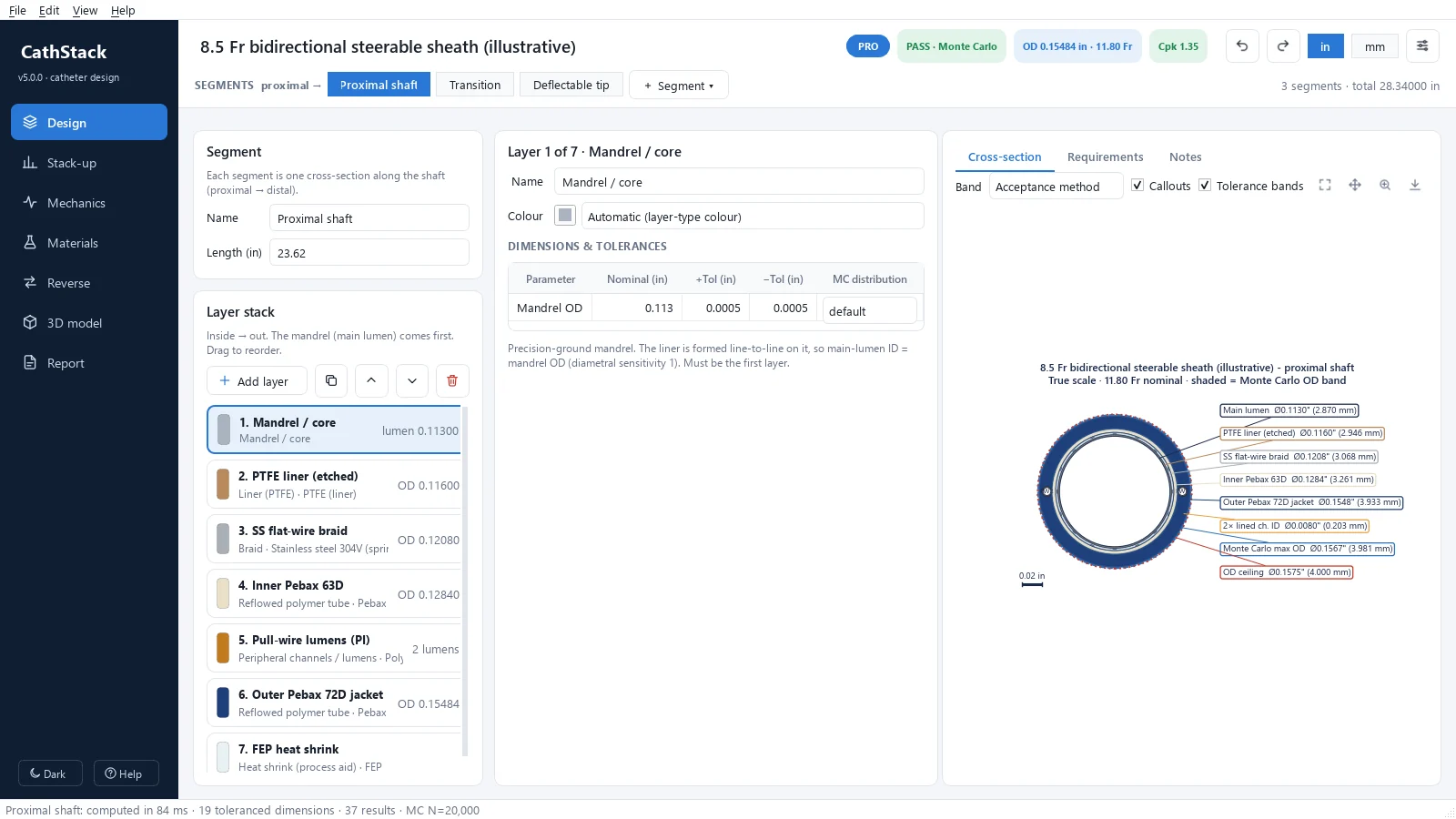
Build the cross-section layer by layer, inside to out. The cross-section redraws to scale as you edit, with callouts and tolerance bands.
- Mandrel, liners, braids (round or flat wire), coils, reflowed jackets, extrusions, lumen channels, heat shrink
- Nominal with asymmetric plus and minus tolerances, and a distribution per dimension for Monte Carlo
- Drag to reorder, duplicate, undo and redo
- Inches or millimetres, French size shown throughout
Stack-up and capability
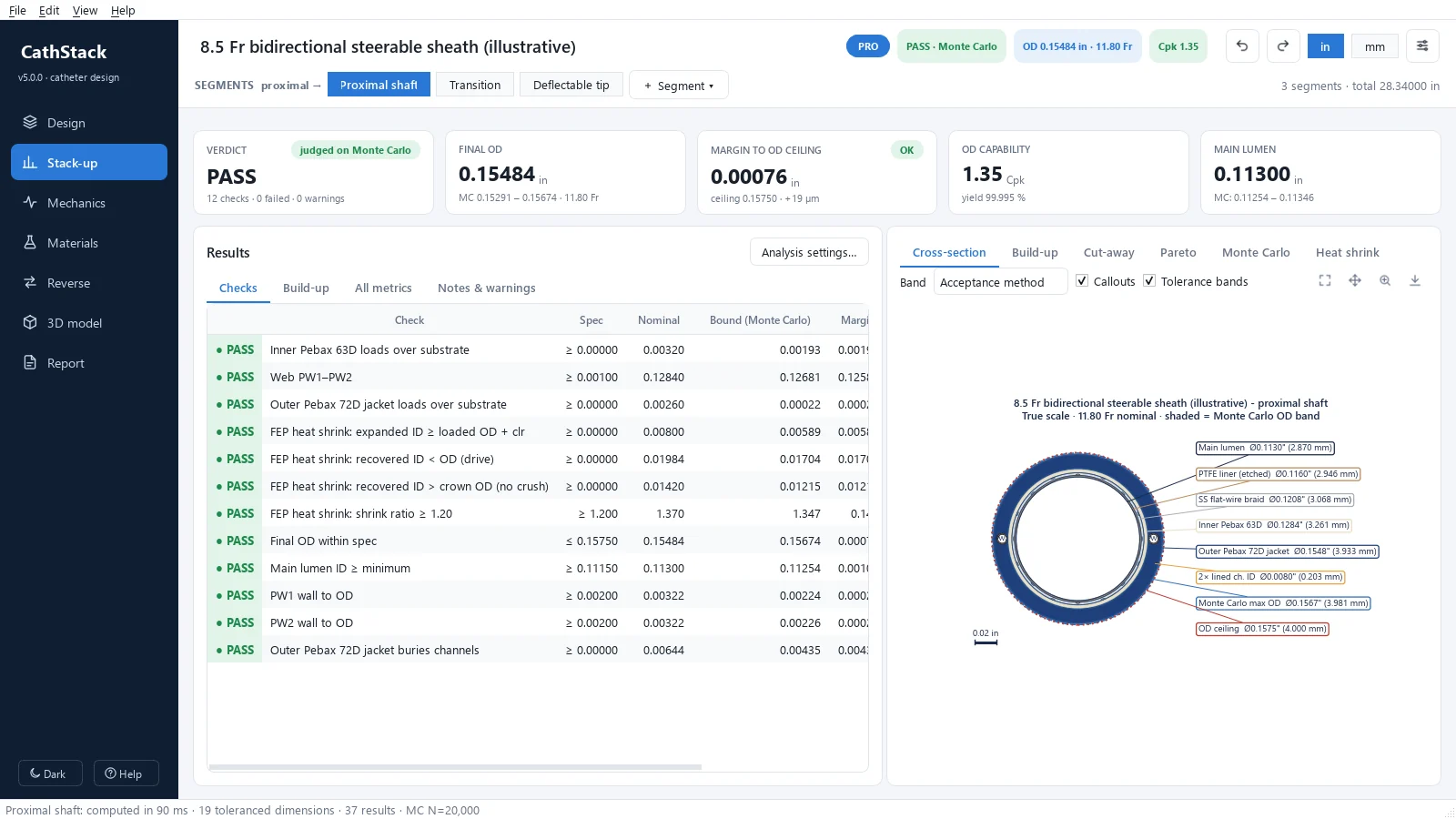
- Worst case, RSS, modified RSS and Monte Carlo (Latin hypercube or random, up to a million samples)
- Acceptance limits for OD, lumens and walls with pass / warning / fail status
- Cp and Cpk, normal or ISO 22514-2 percentile method
- Sensitivities and a contribution Pareto for every result
- Histograms, method comparison and radial build-up charts
Segments along the shaft
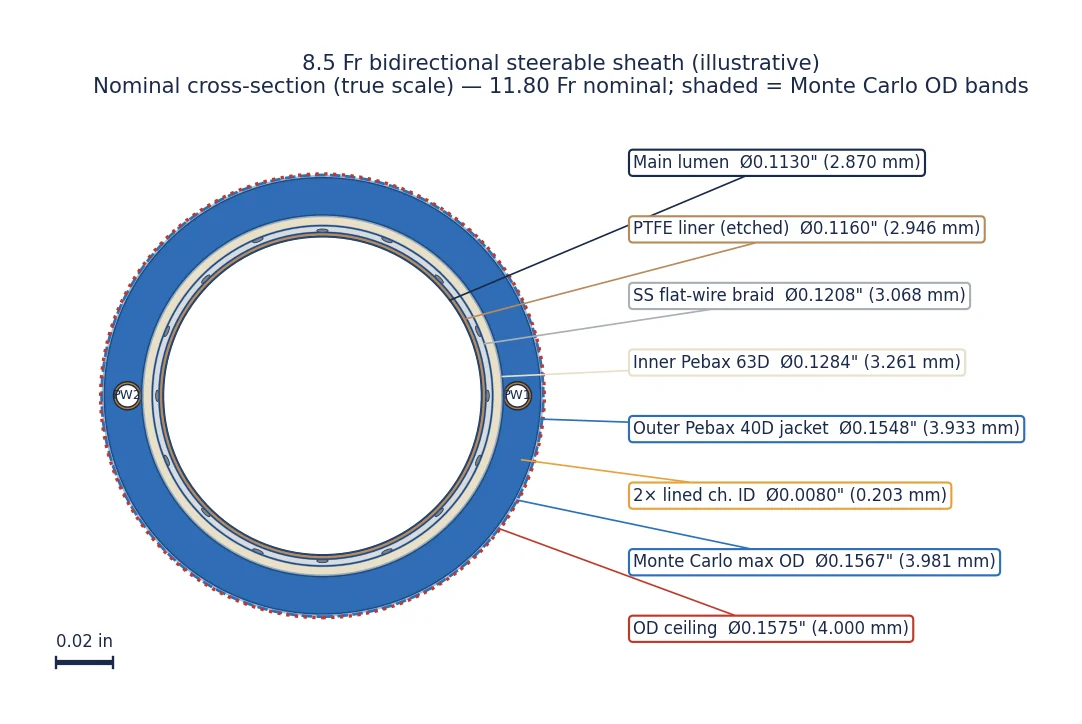
Real shafts change from proximal to distal. Give each segment its own layer stack, durometers, lengths and limits, and see results side by side.
Onshape 3D model
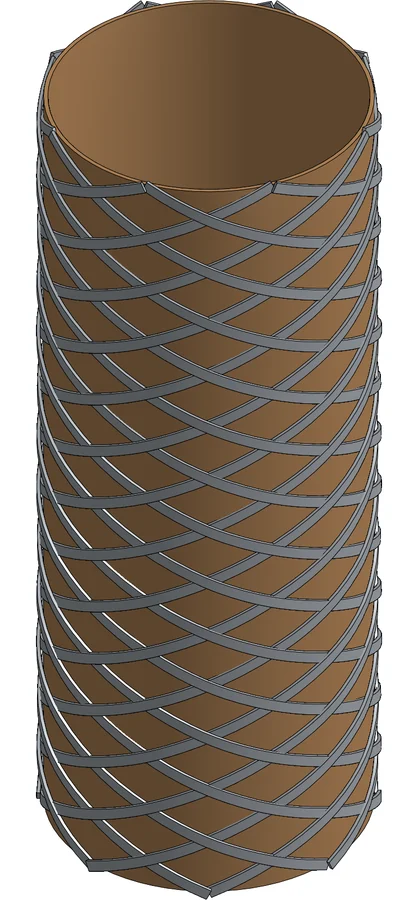
Generate an editable, parametric part studio from your design, using your own Onshape account. One segment with cut-back lengths, or the whole shaft end to end.
- Braid and coil wires modelled as geometry
- Material colours carried over from the design
- Your Onshape API keys stay on your computer
Reports
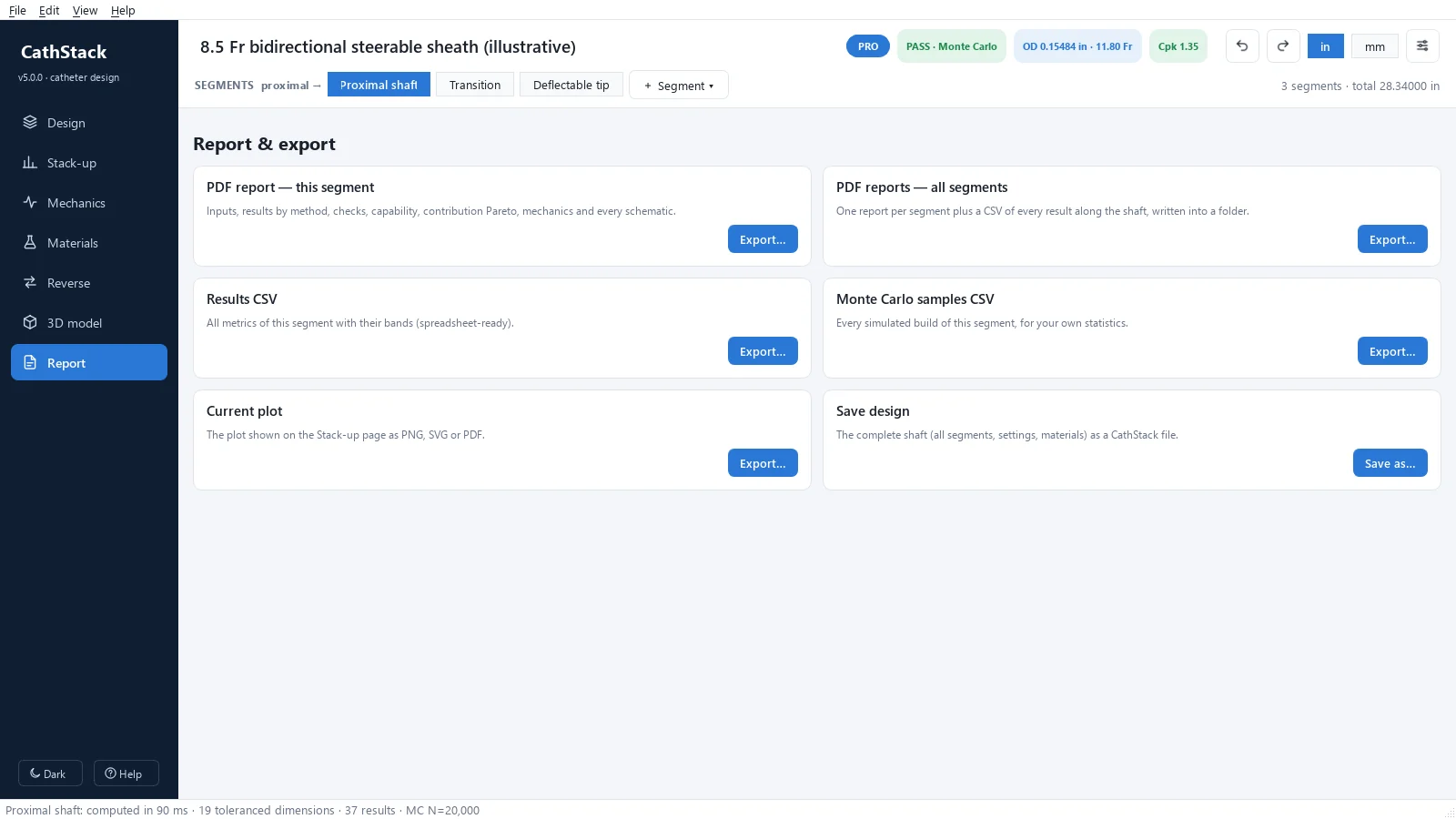
A PDF report with the inputs, results, schematics and charts you select, plus CSV of every result. Ready to attach to a design review or a DHF.
CathStack Pro
For engineers who need to know how the shaft will behave, and which tubes to order to make it.
Mechanical analysis
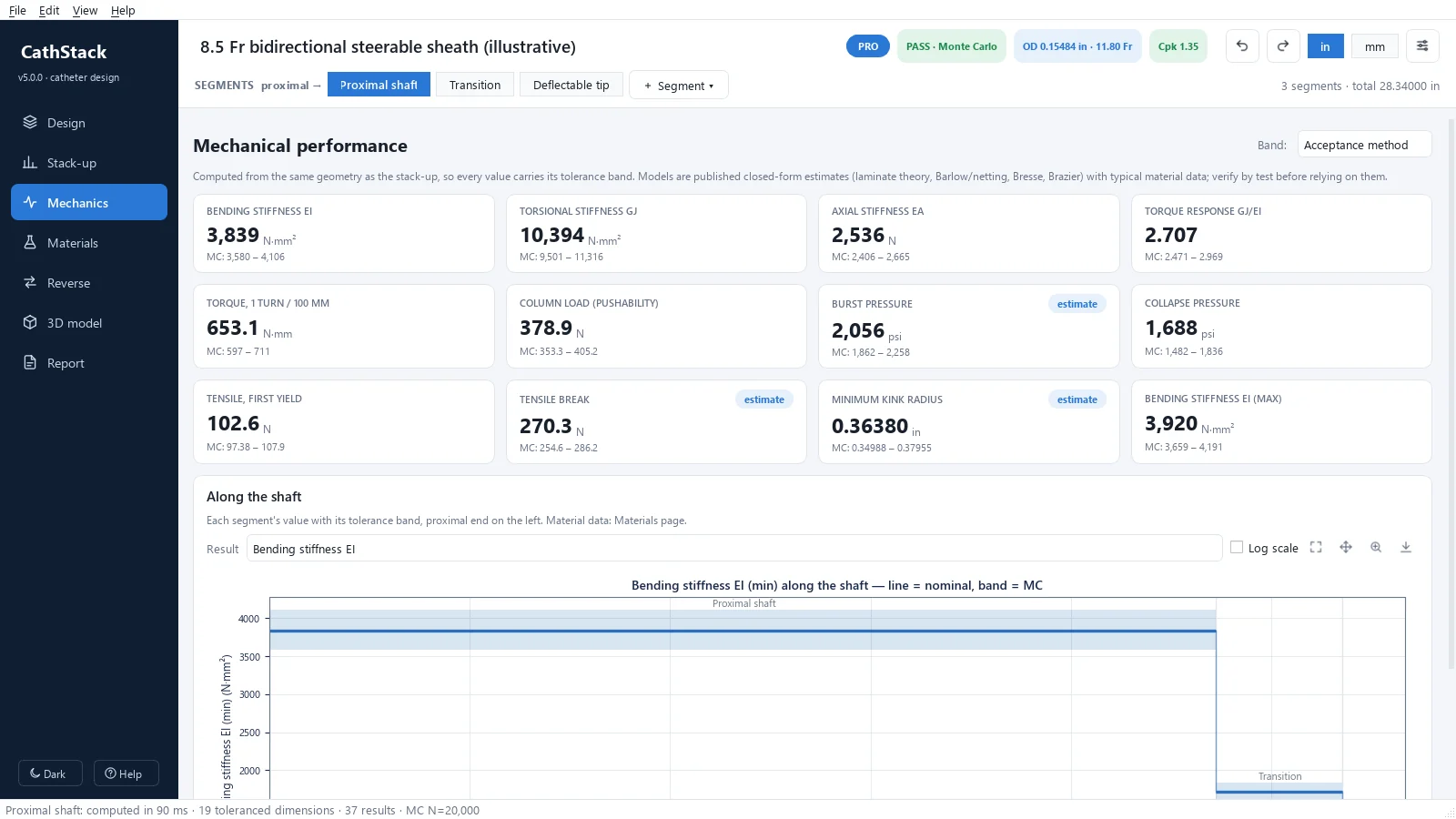
Closed-form models from the catheter and composites literature, run through the tolerance engine so each result has a band and a Cpk.
- Bending (EI), torsional (GJ) and axial (EA) stiffness, laminate theory for braids and coils
- Burst (yield-based, with netting for braids), collapse, tensile yield and break
- Kink radius and a column (pushability) load
- Correction factors to calibrate to your own test data
Models and their limits: methods and validation.
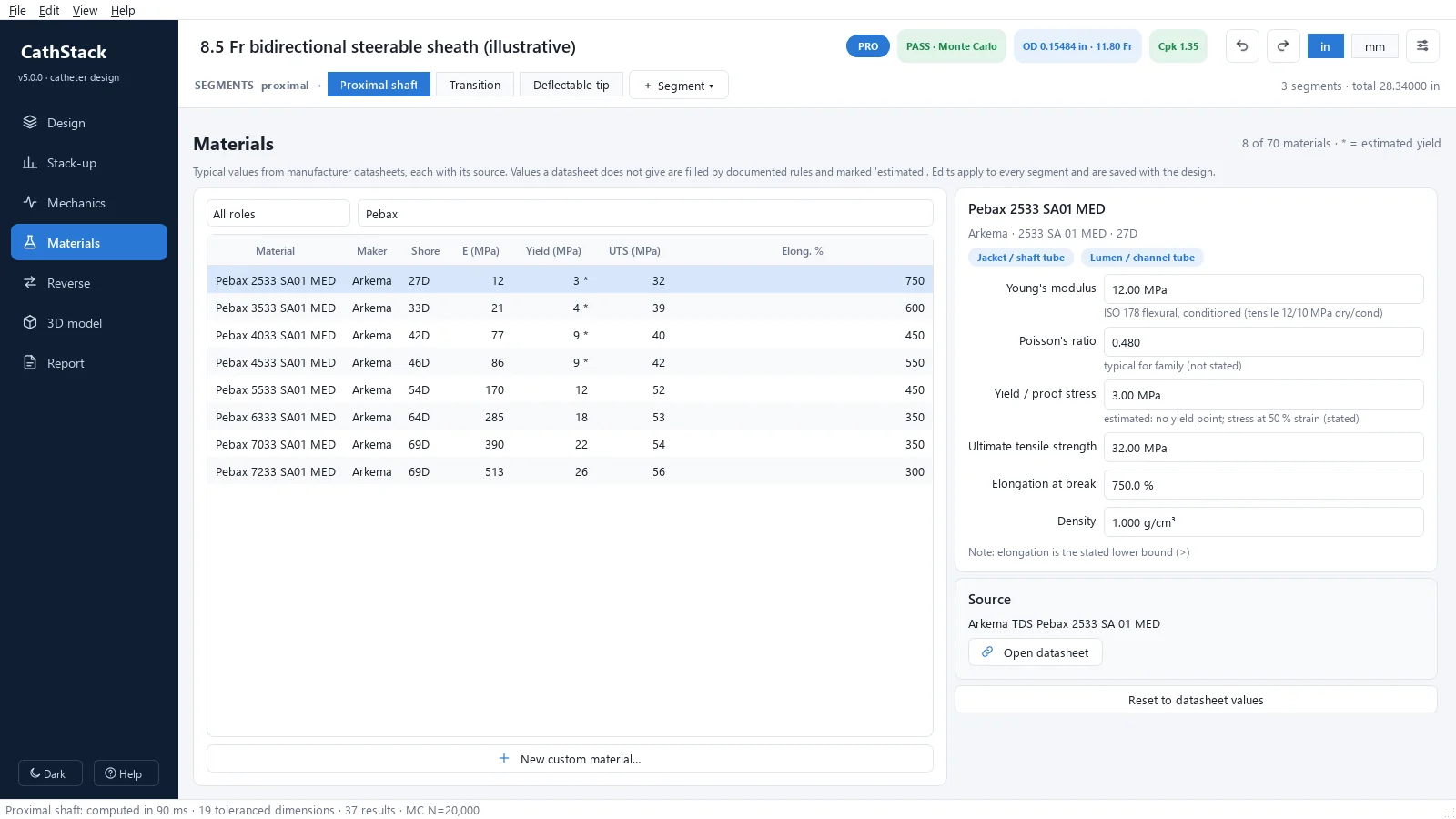
Cited material library
70 grades used in catheters: polyether block amides across the durometer range, nylons, TPUs, PTFE and FEP liners, polyimide, PEEK, stainless steels, MP35N, nitinol, tungsten, platinum-iridium and fibres. Every value shows its source; add your own grades.
Reverse calculations
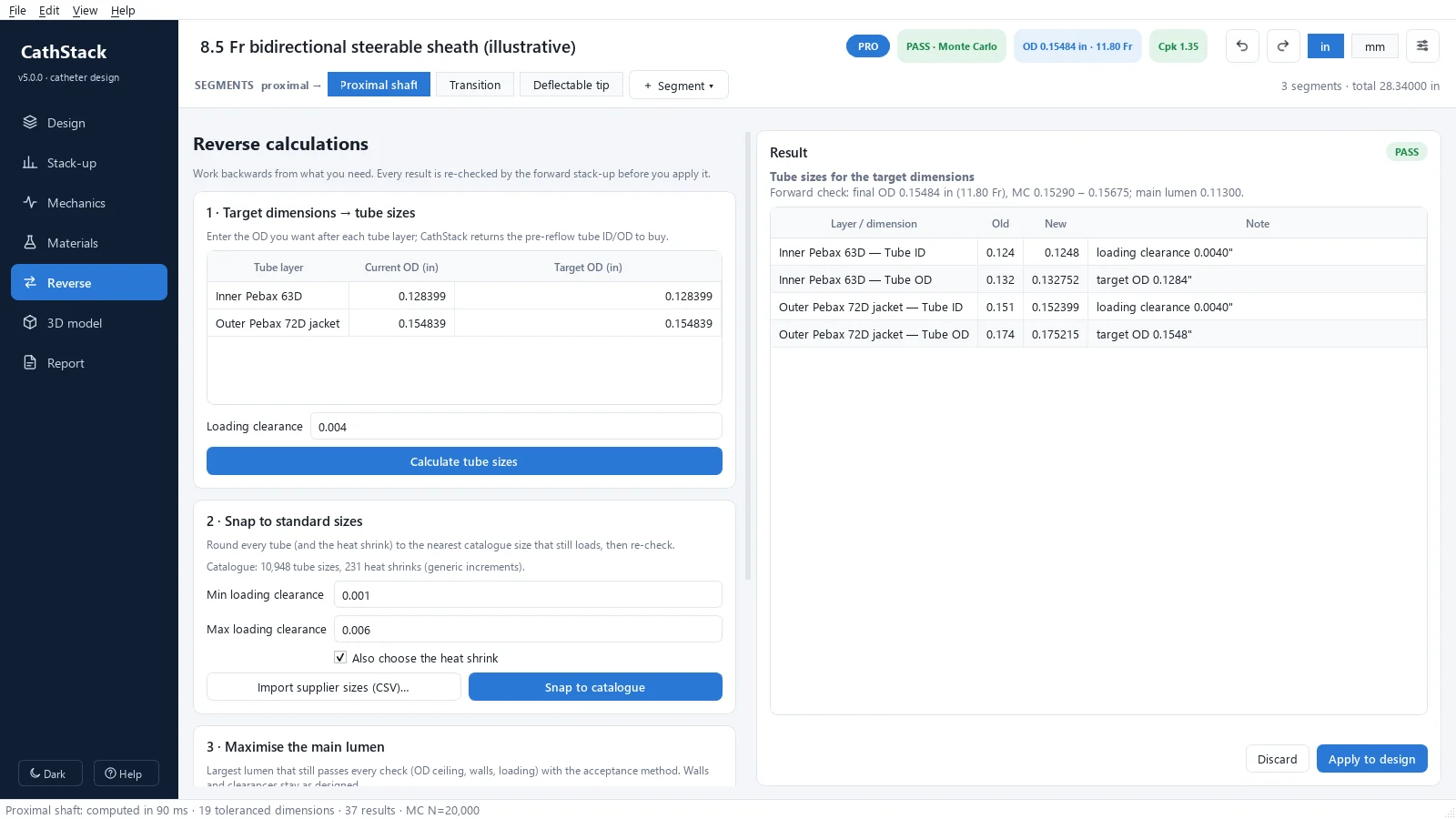
- Target dimensions to the tube sizes to buy
- Snap to standard sizes from a catalogue, or import your supplier's CSV
- Maximise the main lumen under your OD ceiling
- Allocate tolerances to reach a target Cpk
Every suggestion is re-checked by the forward stack-up, and applied only when you choose (and undoably).
See it on your own design
Watch the narrated demo, or ask for a live walkthrough.