
What CathStack calculates, and how far to trust it
Classical, documented methods; every result traced to its inputs. Full equations, assumptions and references ship with the application.
Tolerance analysis
Each layer is a ring model of the build: liners, braids and coils at their crossover thickness, reflowed tubes by area conservation, lumens embedded or buried, heat shrink recovery checks. Results by worst case (with corner search), RSS, modified RSS and Monte Carlo (Latin hypercube or random sampling), with Cp/Cpk by the normal or ISO 22514-2 percentile method.
Closed-form models
Classical laminate theory for braided and coiled plies; section stiffness EA, EI and GJ; burst at gross yielding with netting for braids; Bresse ring collapse capped by wall yield; tensile first yield and break; Brazier kink; Euler column load. Every result runs through the tolerance engine and gets its band.
Cited data
Seventy catheter material grades (polyether block amides, nylons, TPUs, PTFE and FEP, polyimide, PEEK, stainless steels, MP35N, nitinol, tungsten, platinum-iridium and fibres), each value with its manufacturer datasheet. Users can edit values or add grades; edits are saved with the design.
Tested in four layers
Exact maths
For a single isotropic tube every model reproduces its textbook equation; laminate limits (axial wires, hoop wires, 45° shear) are checked.
Physical trends
A braid must raise torsional stiffness and burst; a coil must raise collapse resistance and lower the kink radius; an off-centre lumen makes bending direction-dependent.
Engine invariants
Ten constructions, from a 0.017 in microcatheter to a 24 Fr sheath: every result finite, every statistical band inside the worst case.
Published data
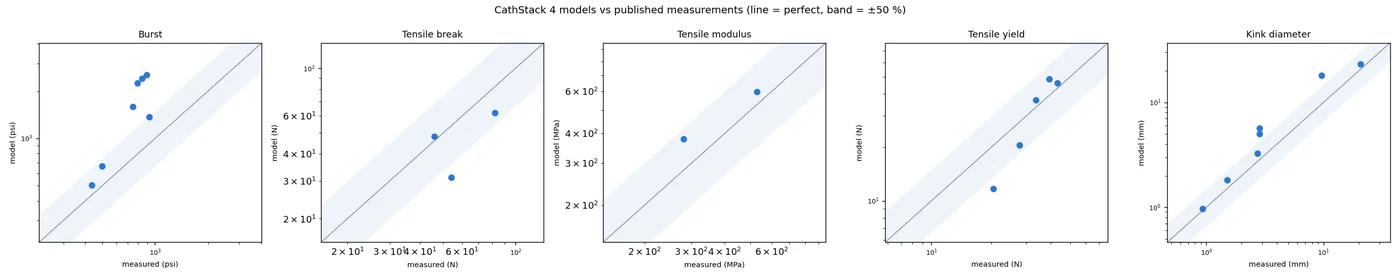
About 30 measurements from seven independent sources (patents, a thesis and peer-reviewed papers) on tubes and shafts with described constructions.
Where the models stand
| Model | Model / measured |
|---|---|
| Bending stiffness vs braid angle (trend) | within 2–4 % |
| Torsion vs braid angle (trend, to 58 PPI) | within 1 % |
| Tensile first yield, coil shafts | 0.57–1.23 (mean 0.91) |
| Kink diameter | 1.04–2.0, conservative |
| Burst, plain tubes | 1.15–1.33 |
| Burst, open low-wire-count braid | 1.5–2.9, over-predicts |
Burst was rebuilt on gross yielding after published data showed the ultimate-strength version over-predicted by 2.5–7.3×. Correction factors (default 1.0) let you calibrate each model to your own tests, and the report lists any factor that is not 1.0.
Seven independent sources
- Burst of plain Pebax 72D tubes, from a medical-device patent
- Tensile break of plain tubes, from a tubing manufacturer's engineering compendium
- Coil-reinforced shafts: tensile modulus, yield and kink, from two peer-reviewed conference papers
- Burst and kink along a braided nitinol microcatheter, from a patent example
- Torque and bending stiffness versus braid PPI, from a master's thesis
- Three-point-bend stiffness of commercial catheters, as an order-of-magnitude check
Full citations, assumptions and the reproducible comparison ship with the application.
Limits, stated plainly
- The mechanics are engineering estimates. They capture trends and relative differences between designs well; absolute burst, kink and tensile break values must be confirmed by test.
- No open dataset gives a full construction with a defined bending or torsion test, so absolute stiffness is checked for order of magnitude only.
- The validation is engineering evidence, not a validation record. For regulated use, validate against your own tests on your own constructions (21 CFR 820 / ISO 13485 §4.1.6).
Classical references
- R. M. Jones, Mechanics of Composite Materials, 2nd ed., 1999.
- S. P. Timoshenko, J. M. Gere, Theory of Elastic Stability, 2nd ed., 1961.
- L. G. Brazier, "On the flexure of thin cylindrical shells and other thin sections", Proc. R. Soc. Lond. A 116 (1927).
- W. C. Young, R. G. Budynas, Roark's Formulas for Stress and Strain.
- ISO 22514-2, statistical methods in process management: capability and performance.